
Frost Depth Calculator for Housing and Small Buildings in Canada
Determining the frost depth for a foundation in Canada can be tricky unless it’s explicitly defined by the local Authority Having Jurisdiction (usually your local Building Department). National Research Council Canada, which publishes the National Building Code of Canada, provides a simplified method in the Illustrated User's Guide - National Building Code of Canada 2020: Part 9 of Division B, Housing and Small Buildings, which is implemented in the calculator below.
Select a province and city, or enter a custom freezing index, to view the estimated frost depth.
Frost depth determined in accordance with Illustrated User's Guide - National Building Code of Canada 2020: Part 9 of Division B, Housing and Small Buildings, Figure 9.12.-3.
Freezing index data taken from Dow Chemical, Tech Solutions 605.0, "Calculating Insulation Needs to Fight Frost Heave by Comparing Freezing Index and Frost Depth," November 2008.
Precautions and Limitations
The method provided above is a simplified and conservative means of determining the frost depth based on climatic data. It uses Figure 9.12.-3 of the Illustrated User's Guide - National Building Code of Canada 2020: Part 9 of Division B, Housing and Small Buildings as a basis, along with freezing index data published by Dow Chemical. The local Authority Having Jurisdiction may require a different frost depth and should be consulted as a final source of reference.
Figure 9.12.-3 noted above has an upper limit of 3,000 °C-days (5400 °F-days), so frost depths extrapolated for values above this should be used with caution.
Foundations normally require a minimum depth, regardless of the calculated frost depth. Consult the National Building Code of Canada for further information.
This page should not be used for locations with permafrost.
How It Works
Figure 9.12.-3 of the Illustrated User's Guide - National Building Code of Canada 2020: Part 9 of Division B, Housing and Small Buildings (copied below for reference) graphs the frost penetration depth vs. the freezing index. If the freezing index is known, the user can read off this chart to determine the approximate frost depth.
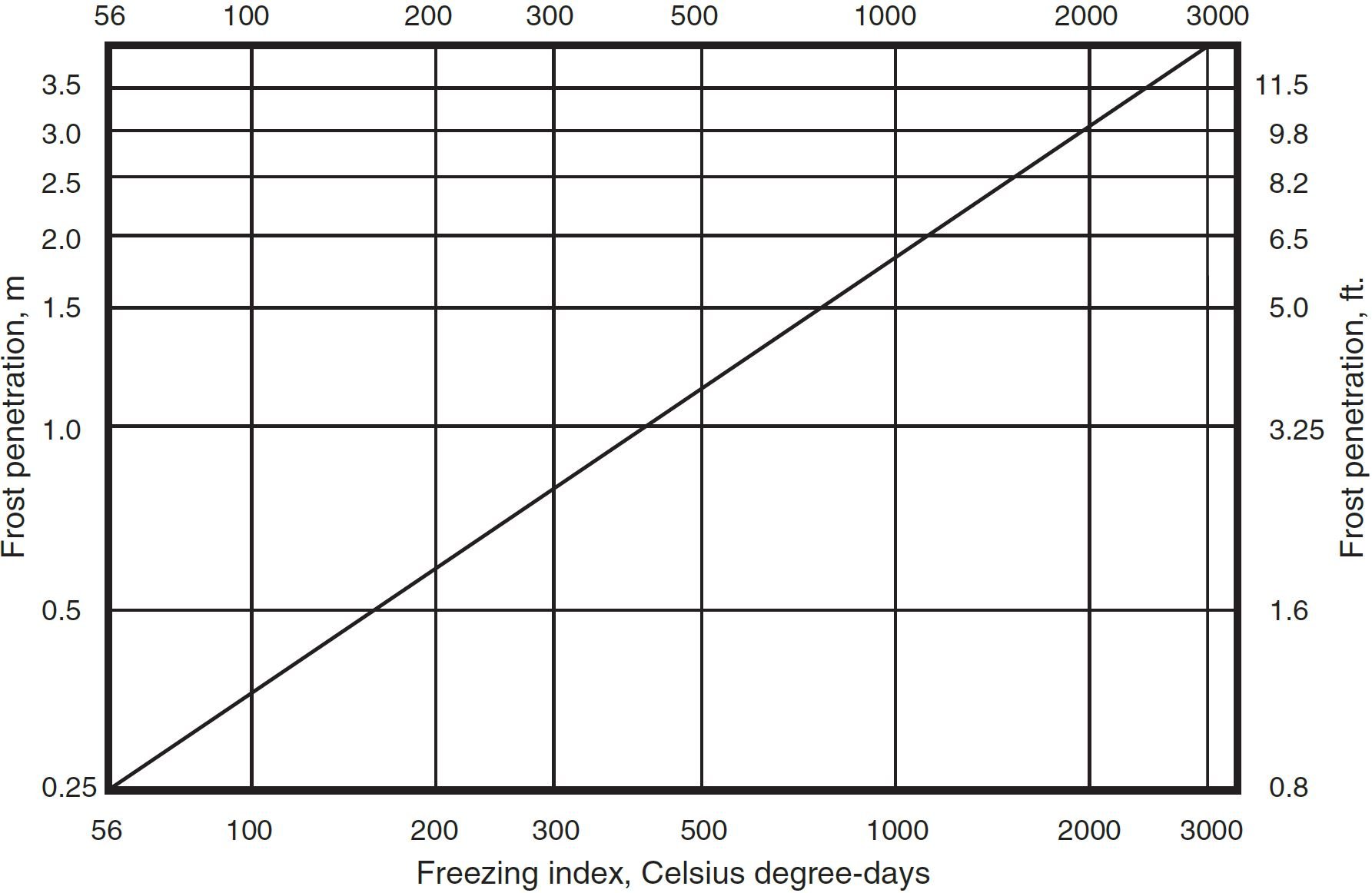
Alternatively, the data from this graph fit a power curve, with the equation for frost depth (FD) being a function of the freezing index (FI) as follows:
